
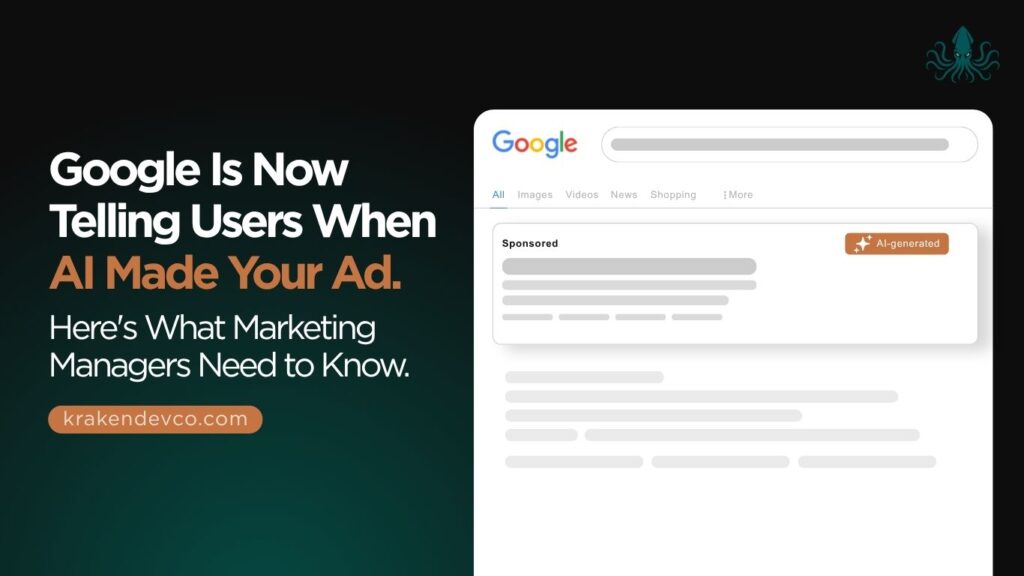
Google has begun rolling out a new “How this ad was made” section within My Ad Center, visible across Search, YouTube, and Discover. The feature lets users see whether an advert was created or edited using artificial intelligence. Adverts built using Google’s own generative AI tools will automatically carry an AI disclosure. For advertisers using third-party AI tools, disclosure is optional and dependent on local regulations.
Google has confirmed that its existing advertising policies remain unchanged. Misleading or deceptive adverts are still prohibited, regardless of how they were made. This update adds a transparency layer on top of existing rules rather than replacing them.
Three reasons this should be on your radar
- Audience trust is now part of your ad performance equation. Users who can see how an ad was made may respond differently to it. If your AI-generated creative is generic or clearly automated, that visibility could affect engagement and conversion rates. This is no longer just a policy question; it is a creative quality question.
- Disclosure rules are inconsistent across third-party tools. If your team uses tools outside of Google’s ecosystem, whether to disclose AI involvement may depend on where your audience is located. Marketing managers need to know which tools their team is using and what the local regulatory position is.
- Your paid media reporting needs to account for this. If disclosure labels begin influencing click-through rates or engagement on YouTube and Discover, that signal will show up in your data. Understanding why performance shifts can help you make faster, better decisions.
Five things to do this week
- Audit your current ad creation process. Make a list of every tool your team uses to produce or edit paid adverts. Note which are Google-native and which are third-party.
- Check your local regulatory position on AI disclosure. If you advertise to audiences in markets with specific AI transparency requirements, confirm whether voluntary disclosure is sufficient or whether it becomes mandatory.
- Review your AI-assisted creative with fresh eyes. If users can now see that AI was involved in making your ad, ask whether the creative is strong enough to hold up to that scrutiny. Weak or generic content becomes more visible under transparency.
- Flag this to your paid media team or agency. If creative production is handled by someone other than you, make sure they are aware of the automatic disclosure for Google AI tools and the options available for third-party tools.
- Monitor performance data after the rollout reaches your campaigns. Watch for any shifts in click-through rate or engagement on Search, YouTube, and Discover. If you see changes, investigate whether disclosure labels may be a contributing factor.
The assumption that could quietly hurt your results
Many marketing managers assume that because Google’s existing ad policies have not changed, this update does not require any action from them. That is not quite right. The policies may be the same, but the user experience has changed. Audiences can now see more about how adverts are made, which means the quality and authenticity of your creative carries more weight than it did before. Ignoring this and continuing to produce low-effort AI-generated ads without reviewing how they appear could quietly hurt your results.
Working with Kraken Dev Co
If you are unsure how your paid media activity connects to your broader lead generation and tracking setup, Kraken Dev Co can help you map that out clearly. We work with marketing managers to ensure that when performance shifts, you have the reporting in place to understand why. Get in touch if you would like a straightforward conversation about your current setup.