What happened
Google Search rankings showed unusual movement between 8 and 12 June. Many SEO professionals reported sharp changes in traffic, visibility and keyword positions during this period.
The timing was particularly difficult for website owners because it came soon after the May 2026 Core Update officially finished on 2 June. Businesses that were already reviewing the impact of that update then had to work out whether this new movement was connected, separate, or temporary.
Across the SEO community, people reported traffic drops, sudden recoveries, shifting keyword rankings and stronger visibility for large marketplace platforms. Some SEOs said the amount of discussion around this period felt greater than during the recent core update itself.
For SMEs, marketing managers and local businesses, this kind of movement can be worrying. Rankings that looked stable one week can change quickly. The impact may appear as fewer enquiries, fewer website visits, changes in Google Business Profile visibility, or weaker performance in local search and Google Maps.
Why this matters
Search visibility can affect enquiries quickly. If your business relies on Google Search, Google Business Profile or Google Maps, sudden ranking changes can influence calls, form submissions, direction requests and website visits.
Rank tracking tools may not show the full picture. During this period, many third-party tools did not reflect the level of disruption being reported by SEOs. Community feedback pointed to significant movement, while most volatility trackers showed only moderate or limited change. This created a clear gap between what people were seeing in their own data and what the tools were reporting.
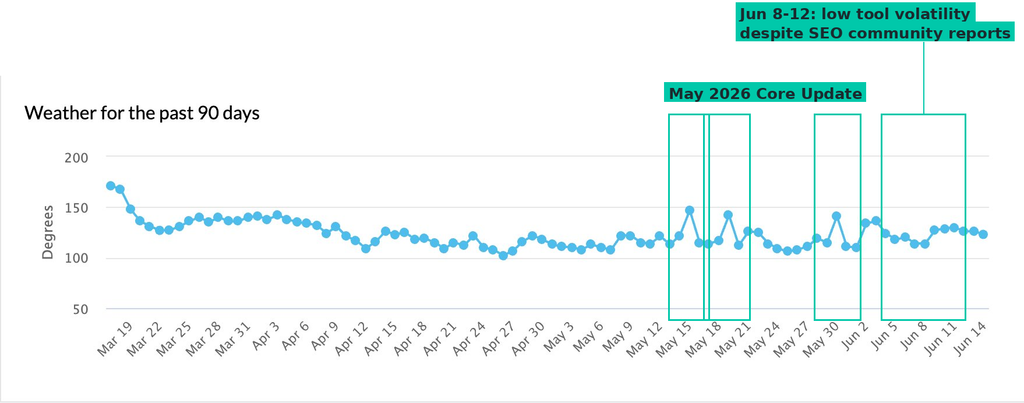
MozCast data showing Google algorithm temperature over the last 90 days. Volatility spikes are visible during the May 2026 Core Update, while the Jun 8-12 period shows low tool activity despite widespread reports of ranking movement across the SEO community.
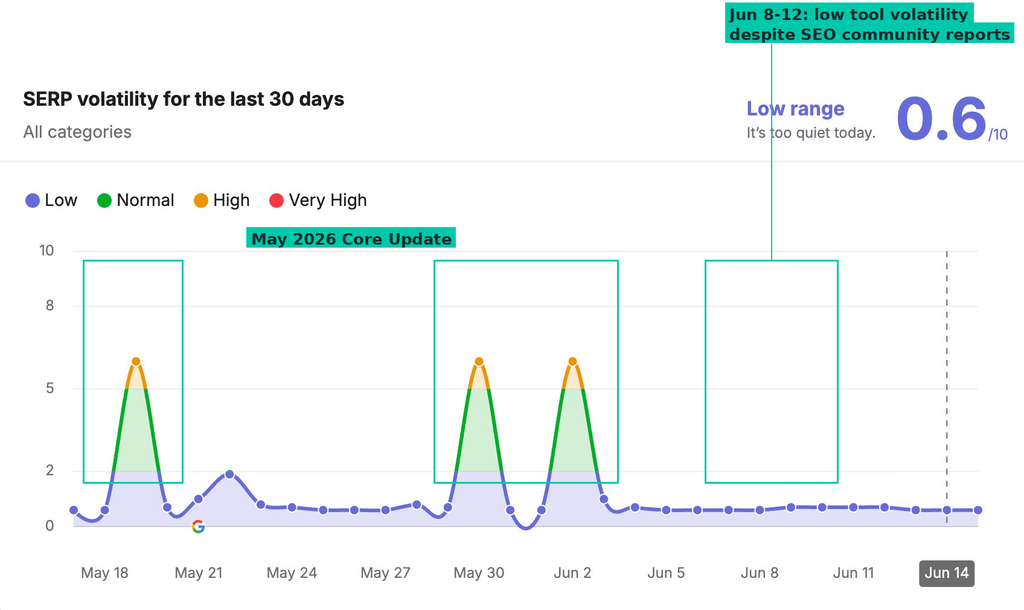
SEMrush Sensor data for the UK over the last 30 days. Tracking tools recorded significant volatility during the May 2026 Core Update but showed low volatility between 8 and 12 June despite widespread reports of ranking movement in the SEO community.
Large platforms may also take up more space in the results. Some website owners reported stronger visibility for large marketplace platforms, which can make organic visibility harder for smaller businesses, particularly in competitive local and service-based markets.
What to do now
Compare traffic, rankings, enquiries and Google Business Profile activity across 8 to 12 June, rather than reacting to one day of data.
Check whether the change affected the whole website or only specific services, locations, keywords or landing pages.
Review Google Business Profile performance, especially calls, website clicks, direction requests and Maps visibility.
Look for sudden keyword movement, but avoid making rushed content or technical changes unless there is a clear pattern.
Keep a record of what changed so you can separate short-term volatility from longer-term ranking movement.
A common mistake to avoid
A common mistake is assuming that every traffic drop means your website has been penalised or that a full SEO overhaul is needed.
Search results can move sharply during volatile periods. Tracking tools may also miss some of the changes that business owners and marketers are seeing in real time.
Before changing page titles, rewriting service pages or making technical edits, look for evidence across rankings, traffic, conversions and local visibility. This gives you a more accurate view of whether the issue is temporary movement or something that needs further attention.
How Kraken Dev Co can help
Kraken Dev Co helps SMEs, in-house marketers and local businesses review ranking changes during volatile search periods without panic or guesswork.
We can assess organic traffic, local SEO performance, Google Business Profile activity and lead generation data to help identify whether a ranking shift is temporary noise or something that needs action.
The aim is simple: clearer evidence, calmer decisions and practical next steps.